Population Density and Air Pollution: Should Incentives Be the Same Across U.S. Cities and States?
DOI:
https://doi.org/10.18335/region.v13i2.672Abstract
Population concentration generates both economic benefits and environmental costs through agglomeration-related spatial externalities. This paper examines how population density shapes fine particulate matter (PM2.5) concentrations across U.S. states over the period 2000–2023, conceptualizing density as a structural driver of nonlinear environmental externalities within regional systems. Using a balanced panel of all fifty states, I estimate fixed-effects models in which logged PM2.5 is modeled as a flexible quadratic function of logged population density, allowing coefficients to evolve over time and across density regimes.
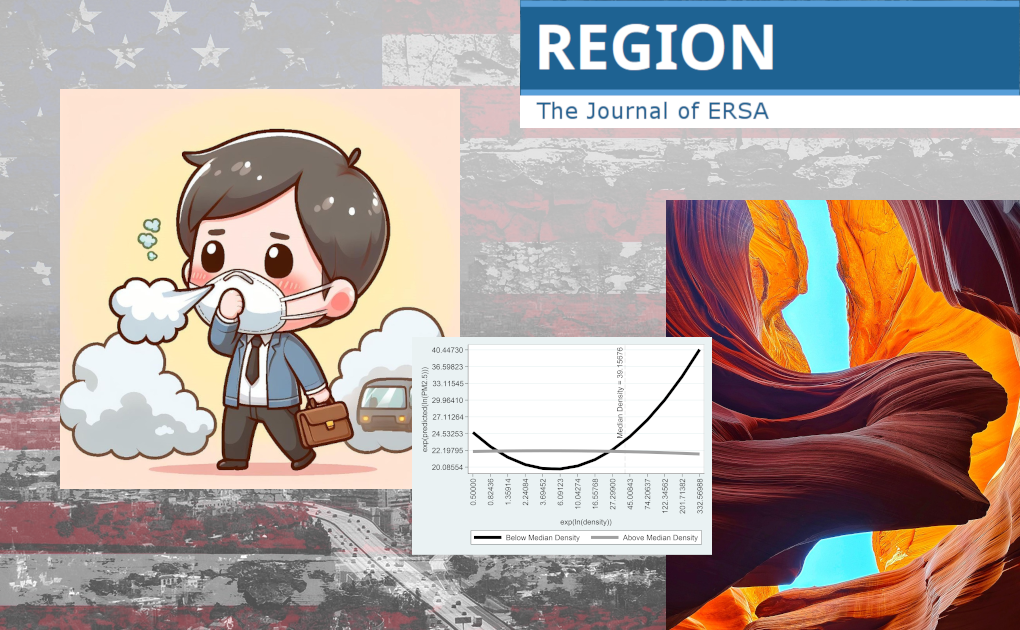
The results reveal a convex relationship between population density and PM2.5, indicating that the environmental externalities of agglomeration increase at an accelerating rate over much of the density distribution. However, the strength of this nonlinear effect has weakened over time, consistent with regulatory adaptation and technological diffusion. A split-regime analysis further shows that the curvature of the density–pollution relationship differs systematically between low- and high-density states, suggesting heterogeneity in regional externality structures.
These findings contribute to the regional science literature by demonstrating that the environmental consequences of population concentration are nonlinear, heterogeneous, and dynamic within an advanced economy context. More broadly, the results highlight the importance of incorporating spatial externalities and governance scale into density-sensitive regional policy design, particularly in transportation investment, land-use planning, and environmental regulation.
References
Climate Change Academy (2025) Aerosols and climate change: Dual roles in warming and cooling. Web page. Available at https://climatechange.academy/introduction-to-climate-change/aerosols-climate-change-warming-cooling
EPA -- U.S. Environmental Protection Agency (2025) Air quality statistics report. Retrieved November 27, 2025, from https://www.epa.gov/outdoor-air-quality-data/air-quality-statistics-report
Fan C, Chien YH, Mostafavi A (2022) Human mobility disproportionately extends PM2.5 emission exposure for low-income populations. Preprint, arXiv. Available at https://arxiv.org/abs/2205.15381
Han S, Sun B (2019) Impact of population density on PM2.5 concentrations: A case study in Shanghai, China. Sustainability 11. https://doi.org/10.3390/su11071968
Hird C, Perron MMG, Holmes TM, Meyerink S, Nielsen C, Townsend AT, Caritat P, Strzelec M, Bowie AR (2024) On the use of lithogenic tracer measurements in aerosols to constrain dust deposition fluxes to the ocean southeast of Australia. Aerosol Research 2: 315–327. https://doi.org/10.5194/ar-2-315-2024
Hoaglin D (2016a) Regressions are commonly misinterpreted. Stata Journal 16: 5–22. https://doi.org/10.1177/1536867x1601600103
Hoaglin D (2016b) Regressions are commonly misinterpreted: A rejoinder. Stata Journal 16: 30–36. https://doi.org/10.1177/1536867x1601600106
IPCC -- Intergovernmental Panel on Climate Change (2021) Short-lived climate forcers. In: Masson-Delmotte V (ed), Climate Change 2021: The Physical Science Basis. Contribution of Working Group I to the Sixth Assessment Report of the IPCC. Cambridge University Press, Cambridge UK
Ito A, Miyazaki Y, Taketani F, Iwamoto Y, Kanaya Y (2023) Marine aerosol feedback on biogeochemical cycles and the climate in the anthropocene: Lessons learned from the Pacific Ocean. Environmental Science: Atmospheres 3: 782–798. https://doi.org/10.1039/D2EA00156J
Kahn ME, Walsh R (2015) Cities and the environment. In: Duranton G, Henderson JV, Strange WC (eds), Handbook of regional and urban economics, Volume 5. Elsevier Science, Amsterdam NL, 405–465. https://doi.org/10.1016/B978-0-444-59517-1.00007-6
LeSage J, Pace RK (2009) Introduction to Spatial Econometrics/ (1st ed.). Chapman and Hall/CRC, New York NY. https://doi.org/10.1201/9781420064254
Mahowald NM (2011) Aerosol indirect effect on biogeochemical cycles and climate. Science 334: 794–796. 10.1126/science.1207374
Ramanathan R (2002) Introductory Econometrics with Applications/ (Fifth ed.). South-Western Thomson Learning, Mason OH
Sellegri K, Simó R, Wang B, Alpert P, Altieri K, Burrows S, Hopkins F, Koren I, McCoy I, Ovadnevaite J, Salter M, Schmale J (2024) Influence of open ocean biogeochemistry on aerosol and clouds: Recent findings and perspectives. Elementa: Science of the Anthropocene 12: 00058. https://doi.org/10.1525/elementa.2023.00058
Tauberer J (2025) Historical population of the U.S. States - Spreadsheet (CSV). Github repository. Retrieved November 27, 2025, from https://github.com/JoshData/historical-state-population-csv
Wang Q, Kwan MP, Zhou K, Fan J, Wang Y, Zhan D (2019) The impacts of urbanization on fine particulate matter (PM2.5) concentrations: Empirical evidence from 135 countries worldwide. Environmental Pollution 247: 989–998. https://doi.org/10.1016/j.envpol.2019.01.086
WHO -- World Health Organization (2021) What are the WHO air quality guidelines?newblock https://www.who.int/news-room/feature-stories/detail/what-are-the-who-air-quality-guidelines
WHO -- World Health Organization (2025) Health and air quality co-benefits of climate change mitigation: Technical brief. World Health Organization
Wooldridge JM (2009) Introductory econometrics: A modern approach/ (5th ed.). South-Western/Cengage Learning, Mason OH
Zhang Y, Zhou Q, Chang K (2022) Long term variation of population exposure to PM2.5 in Eastern China: A perspective from SDG 11.6.2. Preprint. available at https://arxiv.org/abs/2208.14275
Downloads
Published
How to Cite
Issue
Section



License
Copyright (c) 2026 Yuval Arbel

This work is licensed under a Creative Commons Attribution 4.0 International License.
REGION is an open journal, and uses the standard Creative Commons license: Copyright We want authors to retain the maximum control over their work consistent with the first goal. For this reason, authors who publish in REGION will release their articles under the Creative Commons Attribution license. This license allows anyone to copy and distribute the article provided that appropriate attribution is given to REGION and the authors. For details of the rights authors grant users of their work, see the "human-readable summary" of the license, with a link to the full license. (Note that "you" refers to a user, not an author, in the summary.) Upon submission, the authors agree that the following three items are true: 1) The manuscript named above: a) represents valid work and neither it nor any other that I have written with substantially similar content has been published before in any form except as a preprint, b) is not concurrently submitted to another publication, and c) does not infringe anyone’s copyright. The Author(s) holds ERSA, WU, REGION, and the Editors of REGION harmless against all copyright claims. d) I have, or a coauthor has, had sufficient access to the data to verify the manuscript’s scientific integrity. 2) If asked, I will provide or fully cooperate in providing the data on which the manuscript is based so the editors or their assignees can examine it (where possible) 3) For papers with more than one author, I as the submitter have the permission of the coauthors to submit this work, and all authors agree that the corresponding author will be the main correspondent with the editorial office, and review the edited manuscript and proof. If there is only one author, I will be the corresponding author and agree to handle these responsibilities.